
Guide to Choosing Office Filing Cabinet Sizes for Every Area
Office filing cabinets help businesses store documents neatly and securely and optimize their workspaces. However, each area in the office will suit a different group of office filing cabinet sizes, depending on the floor space, volume of documents, and frequency of use. The following article will guide you on how to choose office cabinet dimensions for each space, while also suggesting some premium storage cabinet lines from Okamura.
Key Takeaways: Office filing cabinet sizes should be selected based on the space area, document volume, usage habits, and security requirements of each department.
Okamura cabinet lines, such as the DN Mobile Drawer, KD Storage System, and Personal Locker are suitable choices for modern offices. |
1. Guide to Choosing Office Filing Cabinets for Every Workspace
Every area in the office has different storage needs, so it is not advisable to use the same office filing cabinet sizes throughout the space. Choosing the right dimensions will help categorize documents scientifically, minimize wasted space, and ensure convenience during daily use.
1.1. Choosing Filing Cabinets for Large Areas
Large office areas typically include the HR & admin department, finance & accounting department, dedicated archives, open-plan workspaces, or large-scale collaborative areas. These are places with a constant flow of documents that need to be stored by department, financial year, document type, or security level.
For these areas, businesses should prioritize wall-mounted shelving units with sturdy structures and multiple tiers to maximize vertical space. The cabinet needs generous capacity, easy document categorization, and seamless accommodation of arch files, document boxes, hanging files, or A4/foolscap paper. Some reference dimensions include:
Standard height: Usually ranges from 1500mm to 1800mm, suitable for multi-tier cabinet designs that make the most of wall height.
Standard width: Ranges from 900mm to 1200mm.
Standard depth: Ranges from 450mm to 500mm, ideal for storing arch files and A4 or foolscap documents without wasting space.

Office filing cabinets for large areas prioritize wall-mounted designs, multiple shelves, and a sturdy structure.
1.2. Choosing Filing Cabinets for Medium Areas
Medium-sized areas are usually team workspaces, manager offices, small meeting rooms, administrative support areas, or offices with a moderate number of staff. These are spaces that still require storing frequently used documents, but are not suitable for tall or bulky cabinet systems.
For this group of spaces, businesses should choose office filing cabinets with a moderate height or integrate them with desks to keep the office layout airy. Low cabinets, 2- to 3-tier cabinets, sliding-door cabinets, or cabinets combined with open shelves are ideal, as they meet storage needs without obstructing the view. Some reference dimensions include:
Standard height: Typically between 1000mm and 1200mm, allowing for convenient access while minimizing visual obstruction compared to tall cabinet systems.
Standard width: Commonly at 900mm or in a modular format.
Standard depth: Maintained at 450mm.

For medium areas, you should prioritize cabinets with a height of about 1000-1200mm to ensure an unobstructed view.
1.3. Choosing Filing Cabinets for Small Areas
Small office areas are often individual workstations, under-desk spaces, narrow reception desks, startup offices, small rooms, or areas with restricted walkways. For these spaces, filing cabinets must be compact, flexible, and non-obstructive to movement.
You should prioritize mobile pedestals, personal drawers, low cabinets, sliding-door cabinets, or models that fit neatly under a desk. If you need to increase storage capacity, you can utilize the top surface of a low cabinet as a printer stand, a shelf for frequently used documents, or a light decoration area. Some reference dimensions include:
Mobile cabinet dimensions: Standard height is around 658.5mm, width is 390mm, and depth is 577mm. These sizes help the cabinet fit perfectly under the desk.
Low cabinet/auxiliary cabinet dimensions: The height can range from 650 to 1000mm when placed under or next to a desk. For cabinets taller than 1000mm, they should be placed against the wall and only used if the small space still has enough room for a walkway.
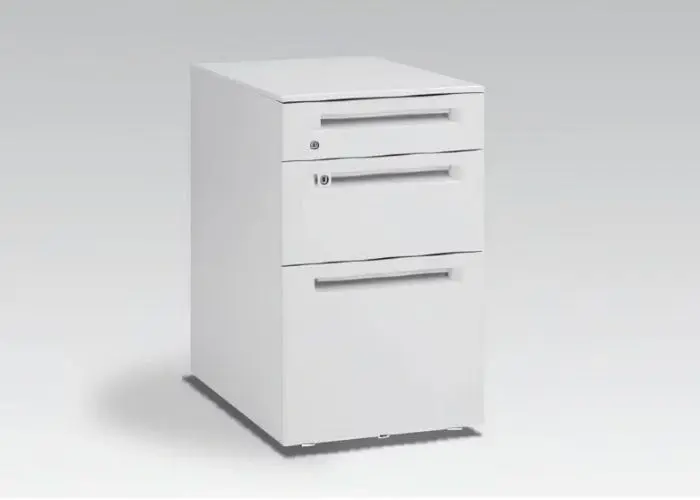
Small office areas will suit mobile cabinets, personal lockers, or space-saving under-desk cabinets.
2. Important Notes When Choosing Office Filing Cabinet Sizes
Besides height, width, and depth, businesses need to consider additional factors when selecting office filing cabinets:
Door clearance: For swing-door cabinets, add at least 450mm to 600mm of clearance at the front so the doors can open fully without bumping into a seated person or blocking the aisle. If the space is too narrow, consider switching to sliding doors or drawer cabinets.
Shelf load capacity: Paper documents, archival files, and document boxes can put immense pressure on shelves if stored for extended periods. Therefore, you should check the cabinet's load capacity specifications (typically 30-50kg per shelf) to ensure it does not sag under pressure.
Anti-tilt system: For drawer cabinets, height and depth need to be accompanied by a safety mechanism to keep the cabinet's center of gravity stable. The anti-tilt mechanism usually only allows one drawer to be opened at a time, preventing multiple heavy drawers from being pulled out simultaneously and causing the cabinet to lose balance. This is a particularly crucial criterion for lateral filing cabinets, multi-drawer cabinets, or cabinets placed in high-traffic areas.
Product quality and price: Balance your investment budget with material quality (thickness, paint technology) to ensure long-term storage efficiency and avoid wasteful repairs or early replacement costs.
Reputable brands: Prioritize manufacturers with a long history and transparent warranty policies to ensure mechanical quality, durability, and stable operation.
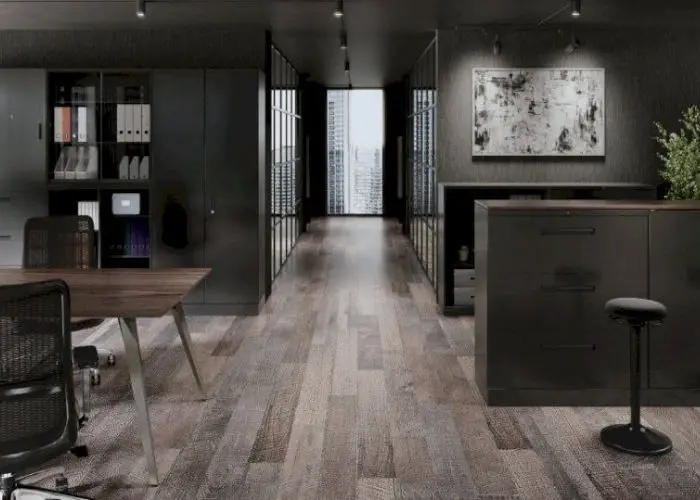
When choosing an office filing cabinet, pay attention to the door clearance, shelf load capacity, and the cabinet's anti-tilt feature.
3. Top 3 Premium Office Filing Cabinet Lines from Okamura
Okamura is a premium office furniture brand from Japan, renowned for over 80 years of development and continuous innovation in modern workspace design. Okamura products are highly regarded for their blend of aesthetics, durability, and optimal functionality, catering to the flexible needs of modern businesses.
For the office filing cabinet category, Okamura offers various product lines suitable for personal storage, departmental filing, and modern workspace layouts. Here are 3 standout cabinet lines for your consideration:
3.1. DN Mobile Office Cabinet
DN Mobile is a flexible personal cabinet model, perfect for storing documents and important items right at the workstation. This line features a compact, easily movable design and can be placed under a desk or in areas requiring personal storage.
Optimized design: With reference dimensions of H658.5 x W390 x D577mm, DN Mobile is ideal for placing under a desk, helping to store personal documents without taking up extra floor space. Its compact shape also makes it easy to pair with a variety of desk models and office styles.
Safety latch: The latch keeps the drawers secured during movement, minimizing the risk of them opening on their own and ensuring the safety of the documents inside.
Anti-tilt safety axis: This mechanism prevents multiple drawers from opening simultaneously, reducing the risk of the cabinet tipping over when loaded with files.
Lockable casters: Wheels make it easy to move the cabinet when repositioning it or cleaning the work area, and they can be locked firmly in place when needed.
Security lock: The cabinet is equipped with a lock for all drawers, making it suitable for storing personal documents, internal paperwork, or other valuable items securely.
This cabinet line is perfect for personal workspaces, small offices, employee desks, or areas that require document storage close to the user.

The DN Mobile office cabinet is a compact line with flexible casters, helping to optimize storage and move easily around the modern workspace.
3.2. KD Storage System Office Cabinet
KD Storage System is a versatile storage solution for modern offices, featuring a customizable modular design to efficiently organize documents and divide the workspace. This cabinet system can also be used as a partition to separate areas while maintaining aesthetics.
Layout flexibility: This is a multi-purpose modular storage system that allows assembling and customizing heights from 1 to 6 tiers. Diverse dimensions of H300 - 2100 x W900 x D450 (mm) fit various spaces and installation positions.
Smart, user-friendly design: The hinged doors can open a full 180°, allowing users to access all documents without restricted opening angles. Additionally, sliding doors help save space in walkways.
Safety and security: The cabinet is equipped with a smart locking system that prevents multiple drawers from opening simultaneously, minimizing tipping risk, and a master lock mechanism to ensure safety when not in use.
High durability: The KD Storage System stands out with its flexible swing or sliding door designs and cold-rolled steel thickness of 0.7mm - 1.0mm, ideal for large-volume document storage needs.
The KD Storage System is suitable for large and medium areas such as admin, accounting, HR departments, or archive rooms.

The KD Storage System is a flexible modular cabinet system that can be customized and used as a partition to optimize the workspace.
3.3. Personal Locker Office Cabinet
Personal Locker is a secure personal storage solution, ideal for modern office environments. With diverse designs in door materials and styles, this product suits various office layouts, such as against a wall, at the end of a desk, or as a standalone unit.
Flexible design: The modular locker can be arranged in multiple sizes and layouts (standalone, wall-mounted, end-of-desk), fitting perfectly into any office space and easy to configure based on usage needs.
High security: The locker comes with secure locking options such as key, combination, and push-button locks, allowing users to choose the option that best protects their personal belongings.
Convenient to use: The locker features height-adjustable shelves, document drop slots, and integrated OA outlets for charging laptops and phones right inside the cabinet, offering maximum convenience to users.
This line is suitable for open offices, flexible workspaces, or areas requiring personal storage for employees. Unlike departmental filing cabinets, the Personal Locker is better suited for storing personal items, private belongings, work devices, and small-scale internal documents.

Personal Locker brings convenience to usage, optimizes the workspace, and ensures safety and practicality.
To explore detailed models of Okamura cabinets, please click HERE. |
4. Frequently Asked Questions
Office filing cabinets are essential furniture pieces that help optimize storage, secure documents, and elevate the professionalism of the workspace. However, many businesses still wonder how to choose the right material, size, and design.
1. What is the difference between swing doors and sliding door filing cabinets?
Swing doors allow you to view and retrieve documents conveniently, but require front clearance to open. Sliding door cabinets are more space-saving because the doors slide horizontally, making them ideal for offices with narrow aisles, desks placed close to the cabinet, or high-traffic areas.
2. Should I choose a tall or a low filing cabinet?
Businesses should decide based on the room size, document volume, and actual frequency of use:
Tall filing cabinets: Suitable for archive rooms, admin and accounting departments, or areas with a large volume of files that need to be sorted by shelves.
Low filing cabinets: Suitable for manager offices, small meeting rooms, teamwork areas, or spaces that need an unobstructed, airy view.
3. When should I choose a modular filing cabinet?
Modular filing cabinets are ideal when a business needs a storage system that can be expanded, reconfigured, or synchronized across departments. This type is especially suitable for growing offices, those needing to divide workspaces, or anticipating future layout rearrangements.
Choosing the right office filing cabinet sizes must be based on the space area, document volume, usage frequency, and security requirements of each zone. For large offices, prioritize tall cabinets with multiple shelves and massive storage capacity. For medium spaces, low or sliding door cabinets strike a balance between functionality and an airy feel. For small areas, mobile pedestals or personal lockers are ideal space-saving options.
Businesses interested in exploring Okamura office filing cabinets can contact official showrooms or authorized dealers in Vietnam for expert consultation on cabinet models, sizes, and configurations that are perfectly suited to your specific workspace.